
On the extrusion line, consistency is everything. When melt pressure at the die head adapter begins to fluctuate erratically, the final product suffers from dimensional variations, surface waviness, wall thickness inconsistencies, and internal stress voids.
Achieving a steady, homogenous flow requires understanding how material is transported, sheared, and pressurized from the feed throat all the way to the final die exit.
1. Root Causes of Melt Pressure Surging
Pressure instability rarely originates at the die itself; instead, it is usually a symptom of upstream variations traveling down the barrel.
Starvation in the Feed Zone: If your gravimetric feeder fails to deliver a consistent mass flow rate of polymer granules, the starvation-to-flood ratio fluctuates, causing density waves to move down the segment barrel.
Improper Modular Configuration: If the transition from distributive conveying elements to high-shear kneading elements is too abrupt, the polymer melt can experience periodic flow blockages and sudden releases.
2. The Role of Screw Geometry in Pressure Stabilization
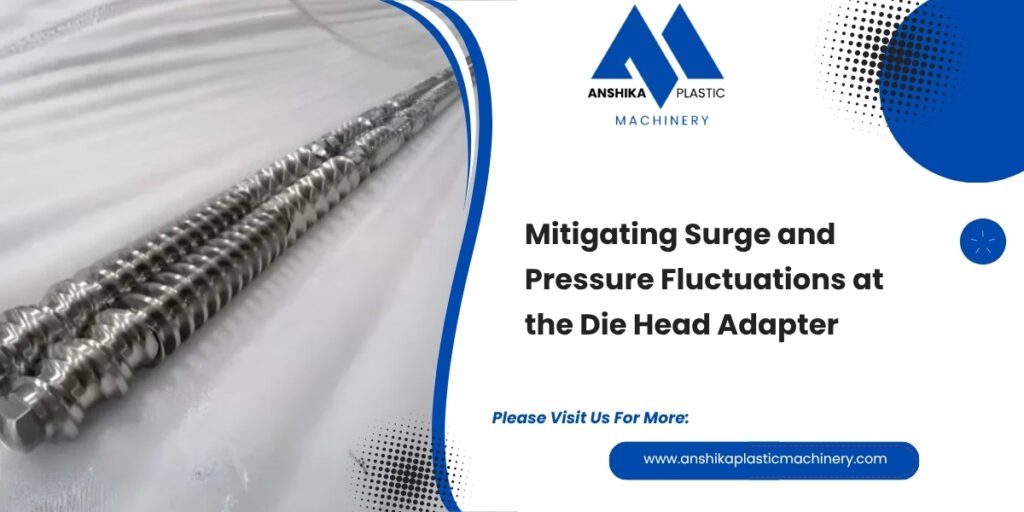
The design of your internal screw profile dictates how smoothly pressure builds up toward the discharge end.
Using Melt Sealing Elements: Incorporating reverse-flighted elements or neutral mixing blocks helps create a stable dynamic seal, preventing upstream pressure surges from breaking through to the die adapter.
Optimizing Flight Depth: Gradual reductions in flight depth help compress the melt progressively rather than forcing sudden volume restrictions.
To enhance your line’s pressure stability and maintain tight volumetric control, equip your machine with high-precision Screw Elements engineered for uniform material delivery.
3. Thermal Fluctuations and Melt Viscosity
Temperature control directly impacts polymer viscosity. If your heating zones or barrel cooling circuits fluctuate by even a few degrees, the melt viscosity will shift instantly.
Higher temperatures lower viscosity, causing pressure to drop.
Lower temperatures raise viscosity, causing pressure spikes.
The Fix: Regularly calibrate thermocouples and ensure your PID controllers are tuned correctly to prevent thermal cycling along the entire length of your twin extruder machine.
4. Practical Steps to Stabilize Extrusion Pressure
Audit Upstream Feeding: Switch to advanced gravimetric feeding systems to guarantee absolute consistency in weight-per-hour input.
Review Screw Profiles: Replace worn or mismatched components that allow backflow or uneven pocket filling.
Inspect the Breaker Plate and Screen Pack: A heavily clogged screen pack will cause progressive pressure climbing until an abrupt breakthrough occurs. Establish a strict schedule for screen pack changes.
For robust operations and reliable component performance across all processing stages, explore our specialized range of Twin Extruder Components designed to eliminate flow irregularities.