
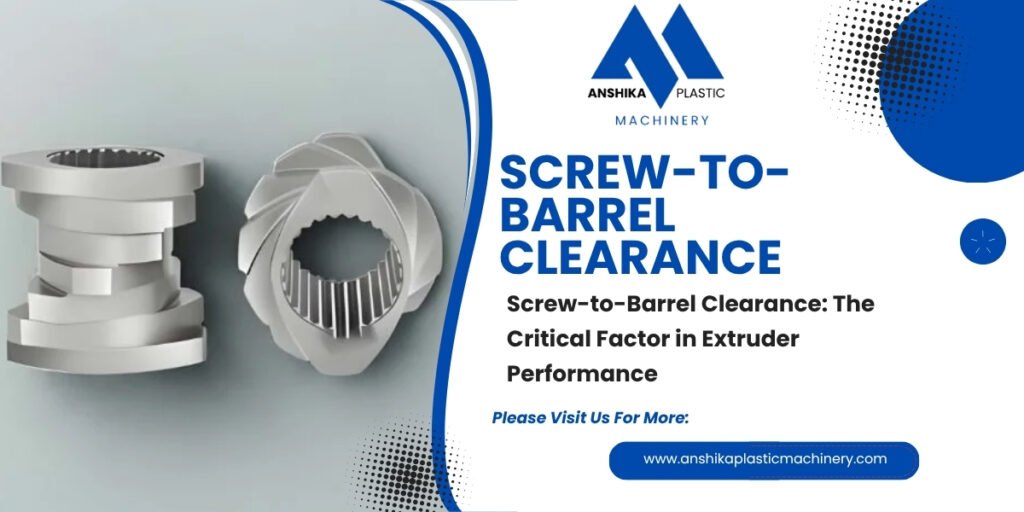
In the world of twin-screw extrusion, there is a fundamental truth: The tighter your tolerances, the better your process.
The gap between the outer diameter of your screw elements and the inner wall of your segment barrels is the most critical dimension in your entire machine. This “radial clearance” is where the magic happens—where material is sheared, melted, and pumped forward. If this gap is too large, your extruder is essentially “leaking” on the inside.
What is "Leakage Flow"?
When you start running your extruder, the pressure at the die-head is significant. Your screws are trying to push material forward against this resistance. If your clearance is perfect, the material is forced toward the die.
However, if your components are worn, the material finds a path of least resistance: it flows backward over the tips of the screw flights into the previous section. This is called “leakage flow.”
The Result: You lose pumping efficiency, you lose residence time control, and your die-head pressure becomes unstable. This is often the hidden culprit behind material surging.
The Lifecycle of Wear
Clearance is not static; it is a moving target that grows larger every day your machine runs.
New Components: Clearances are at the manufacturer’s specification (tight).
Middle-Age: Clearances increase slightly due to normal adhesive/abrasive wear.
End-of-Life: Clearances have widened to a point where the extruder can no longer maintain the pressure required for consistent pelletizing.
How to Check Your Clearance
You should not wait for your output to drop by 20% to check your clearances.
The Physical Audit: When the screw is removed, use internal and external micrometers to measure the diameter of your screw elements and the bore of your barrels.
The “Rule of Thumb”: Generally, once your clearance has opened up to 2.5 to 3 times the original factory specification, your performance will drop off a cliff. At this point, the extruder is no longer a precision tool; it is just a “mixer.”
The Performance Impact
When clearances are too wide, you will notice:
Reduced Throughput: You have to increase the RPM to move the same amount of material, which increases energy consumption.
Temperature Spikes: Because the material is “slipping” backward and being sheared repeatedly in the same zone, it generates excessive frictional heat, leading to material degradation.
Poor Dispersion: The “shear” required to break down pigments or fillers is lost because the material simply flows away from the screw tip rather than being crushed against the barrel wall.
The Anshika Advantage
At Anshika Plastic Machinery, we don’t just supply generic parts. We understand that your machine’s performance depends on the fit. We manufacture screw elements with precision geometry that restores your extruder to its original “tight” performance.
If you suspect your clearances are the reason for your declining output, don’t keep running the machine and wasting electricity. Let our engineering team conduct a professional audit. We can measure your current wear and provide the exact replacement components you need to restore your line’s efficiency.
Restore Your Performance
Are your current clearances eating into your profits? Contact us today to learn about our high-precision replacement barrels and screw elements.