
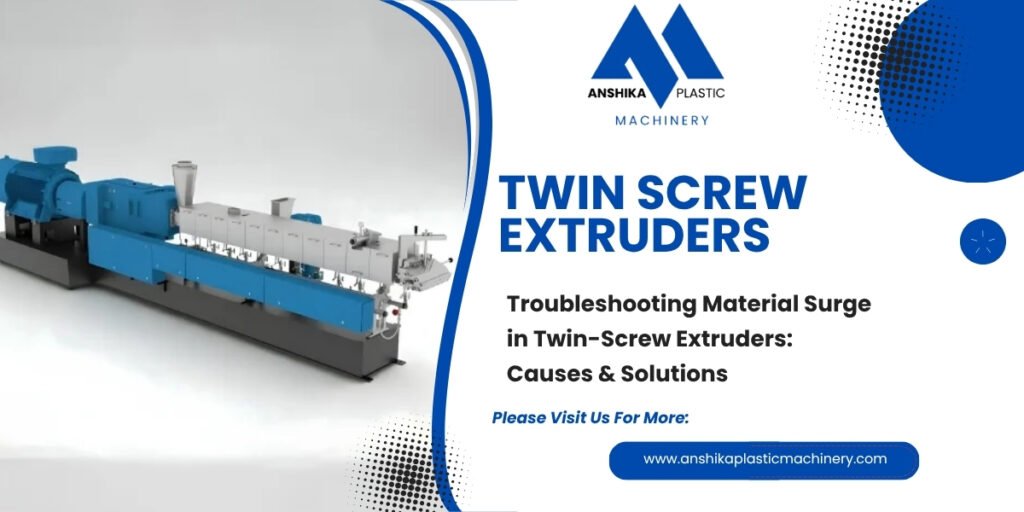
In continuous manufacturing, stability is the ultimate goal. When a twin-screw extruder is running optimally, the polymer melt exits the die head in a smooth, continuous, and predictable flow. However, many production floors are plagued by a phenomenon known as material surging—where the output pulsates, speeds up, and slows down erratically.
Surging is more than just an annoyance; it is a critical process failure. It leads to inconsistent pellet sizes, uneven strand dimensions, and fluctuating product quality that can result in entire batches being rejected. If your extruder is “breathing” or pulsating at the die, the root cause usually lies within your feed system, your barrel temperatures, or most commonly, your screw configuration.
Identifying the Root Causes of Surging
To stop surging, you must first diagnose where the instability is originating. The extruder is a dynamic system, and a fluctuation in one zone will ripple down to the die. Here are the primary culprits behind material surge:
1. Volumetric Inefficiency in the Feed Zone
Twin-screw extruders are typically “starve-fed,” meaning the output rate is determined by the feeder, not the screw speed. The conveying elements in the feed zone must have a higher volumetric capacity than the amount of material being dropped into them.
The Problem: If the pitch of your conveying elements is too small, or if the material has a very low bulk density (like light powders or regrind), the feed zone can become “flooded.” When the feed zone floods, the material is no longer conveyed smoothly; it bridges, slips, and drops into the melting zone in inconsistent clumps.
The Solution: Optimize the pitch of your feed elements. Use long-pitch, deep-flighted screw elements directly under the feed port to rapidly move the bulk material forward before it can accumulate.
2. Improper Pressure Gradients and Melt Seals
A well-designed screw profile creates specific pressure zones. The pressure should build up before restrictive elements (like kneading elements or reverse flights) and drop immediately after them.
The Problem: Surging often occurs when a “melt seal” fails. A melt seal is a fully filled section of the screw that separates two zones (e.g., separating the atmospheric feed zone from the vacuum degassing zone). If the configuration of your kneading blocks fails to maintain this seal, gases can travel backward through the barrel. This pneumatic instability pushes the material forward erratically.
The Solution: Review your screw geometry. Ensure you have an adequate restriction—such as a left-handed (reverse) element or a 90° neutral kneading block—to force the barrel to fill completely and establish a robust melt seal before any venting ports.
3. Mechanical Wear and “Leakage Flow”
Extruders rely on tight clearances between the outer diameter of the screw flights and the inner wall of the segment barrel.
The Problem: As your screw elements suffer from abrasive or adhesive wear, the gap between the flight tip and the barrel wall widens. Instead of being pushed forward, highly viscous polymer melt slips backward through this gap. This is known as “leakage flow.” Because this back-flow is unpredictable and changes with minor temperature or viscosity shifts, it causes the pressure at the die head to fluctuate wildly.
The Solution: Implement a strict maintenance measurement schedule. If your elements have worn past the manufacturer’s recommended tolerance, no amount of process tweaking will fix the surge. You must replace the worn sections with precision-engineered, high-wear-resistance components.
4. Venting and Degassing Issues
If you are processing materials with high moisture content, volatiles, or if you are running recycled Post-Consumer Resin (PCR), degassing is critical.
The Problem: If your vacuum vent is blocked, or if the screw profile beneath the vent is fully filled (rather than partially empty), the trapped gases have nowhere to go. They will build up pressure inside the barrel and eventually “burp” forward out of the die, causing a massive surge of material and ruined product.
The Solution: Ensure the screw configuration directly under the vacuum port consists of long-pitch conveying elements that keep the barrel only partially filled (typically 30-50%). This creates the necessary surface area and free space for gases to be extracted cleanly.
The Role of High-Precision Components
Troubleshooting surging is incredibly difficult if you are working with sub-standard parts. If the splines on your spline shaft are worn, causing rotational hesitation, or if your barrel segments are misaligned, mechanical inconsistencies will always introduce process inconsistencies.
At Anshika Plastic Machinery, we manufacture replacement parts to exact OEM tolerances. We understand that in twin-screw compounding, precision geometry is the only way to guarantee a stable, surge-free process.
Stabilize Your Production Line Today
If you have adjusted your temperatures, calibrated your feeders, and checked your raw materials, but you are still experiencing surging, your screw profile is the bottleneck.
Our engineering team can help you analyze your current configuration, identify the mechanical flaws causing your pressure fluctuations, and provide the exact elements needed to restore a smooth, consistent output.