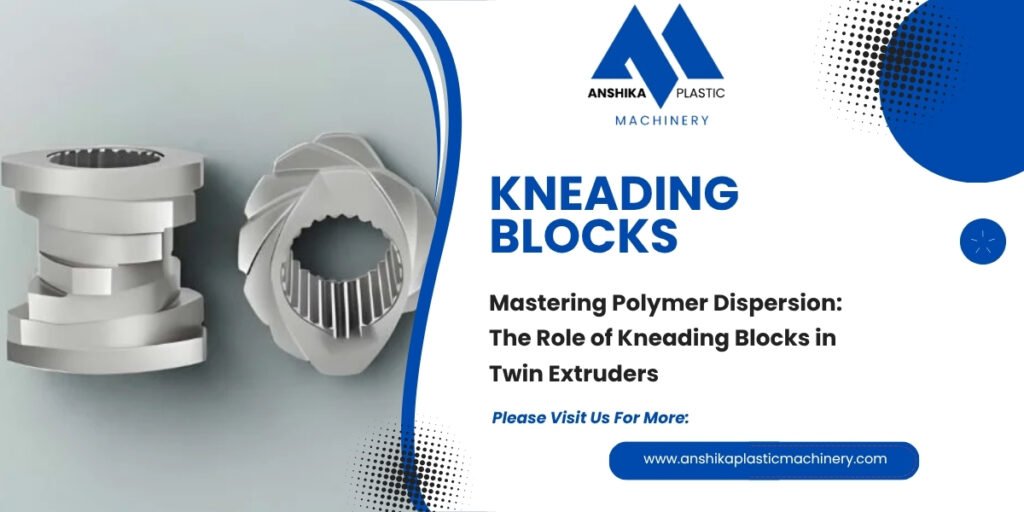
In the world of twin-screw extrusion, the quality of your final product—whether you are processing masterbatch, engineering plastics, or high-performance compounds—depends almost entirely on the configuration of your kneading blocks.
While conveying elements are designed for transport, it is the kneading blocks that perform the critical work of melting, dispersing, and homogenizing. If you are experiencing streaks, un-melted pellets, or inconsistent pigment dispersion, your extruder’s “mixing heart” may be configured incorrectly.
Understanding the Mechanics of Mixing
To optimize your process, you must distinguish between the two primary types of mixing that occur within your screw elements:
Distributive Mixing: This involves spreading additives (like pigments) uniformly throughout the polymer matrix without significantly changing the particle size.
Dispersive Mixing: This involves breaking down agglomerates (like fillers or color concentrates) into smaller particles, which requires high shear force.
The primary tool for controlling these mixing types is the stagger angle of your kneading blocks.
Why Stagger Angles Change Everything
The stagger angle is the relative position of one kneading disc to the next. This angle dictates the intensity of the shear force applied to your polymer:
Low Stagger Angles (e.g., 30° – 45°): These configurations provide more forward conveying capacity and gentler distributive mixing. They are ideal for heat-sensitive materials that degrade easily or for processes where you need to prevent excessive melt temperature.
Neutral Stagger Angles (e.g., 90°): A 90° stagger angle creates a “neutral” zone. These blocks provide very little forward conveyance, which effectively slows down the material and builds high pressure. This is often used to ensure a complete melt before the material reaches the venting port.
High Stagger Angles (e.g., 60° – 90°): These create high-intensity shear, which is essential for dispersive mixing. If you are struggling to disperse heavy fillers or carbon black, you likely need a sequence of high-angle blocks in your mixing zone.
Signs You Need to Re-Evaluate Your Configuration
Many manufacturers run their extruders with the same screw profile for years. However, if your output quality has changed, it is a sign that your configuration is no longer optimized for your current material. Watch for these red flags:
Color Inconsistency: If your masterbatch is showing streaks, your kneading sequence is likely too distributive and lacks the dispersive intensity needed to break down the pigment particles.
Un-melted Pellets: If you see solid pieces in your final extrudate, you are likely lacking a high-pressure zone before the die, which could be solved by adding a 90° neutral block.
High Melt Temperature: Conversely, if your polymer is degrading (yellowing or breaking), you may be using too many high-shear blocks, which are generating excessive heat through friction.
Precision Engineering for Compounding
At Anshika Plastic Machinery, we manufacture high-performance kneading elements that are designed to maintain strict tolerances even under high-torque conditions. We understand that a difference of only a few degrees in your stagger angle can be the difference between a high-grade product and a rejected batch.
Our team works with manufacturers to design custom screw profiles. We don’t just sell components; we provide the engineering calculations necessary to ensure your screw configuration matches the rheology of your specific resins and additives.
Optimize Your Compounding Line
Stop fighting with inconsistent output. Let our technical team help you review your current screw profile and identify where a simple swap of a few elements could dramatically improve your throughput and quality.